


Unlocking Highgate Cemetery: Conserving a Historic Landscape for the Future

Kate White, Project Director at Friends of Highgate Cemetery Trust, outlines the transformative work being carried out to preserve and protect the historic burial ground.
A Landscape Shaped by Change
Over time, the Cemetery has evolved in response to changing social and economic conditions. Periods of high demand for burial space were followed by declining revenues as attitudes to burial practices changed. With limited resources, maintenance became increasingly difficult, and vegetation growth was largely unchecked.
By the 1970s, the Cemetery had fallen into serious decline before being rescued in 1975 by the Friends of Highgate Cemetery Trust, the charity that manages the site today. Unlike many comparable heritage sites, Highgate Cemetery operates without public funding. Its future depends on a careful balance between conservation, visitor income and its continued role as an active burial ground.
.jpg)
A 25-Year Conservation Masterplan
The Trust is now embarking on an ambitious 25-year conservation masterplan ‘Unlocking Highgate Cemetery’, which sets out a clear framework for the site’s future.The aim is not to restore the Cemetery to a single moment in time, but to care for it as a living landscape that continues to evolve while retaining its historic character and significance.
The masterplan is designed around three core priorities: heritage, nature and community. It seeks to conserve the Cemetery’s most significant monuments and buildings, improve the resilience of its landscape and ecology, and expand the ways in which people can access and engage with the site. The approach is conservation-led, focusing on repair and stewardship rather than wholesale restoration.
Over the coming decades, this approach will sustain the Grade I registered landscape, conserve its listed structures, improve access and learning opportunities, and provide the facilities needed to support visitors, staff and volunteers.
In later phases, the masterplan will also deliver a series of new and improved buildings and landscape interventions to support the continued operation of the Cemetery. These include new visitor, operational, community and education facilities, improvements to the public realm, and the sensitive restoration and reinstatement of historic architectural elements. Designed to be both contemporary and in keeping with their surroundings, these interventions will put the Cemetery on a stronger footing for the future while respecting its historic character.
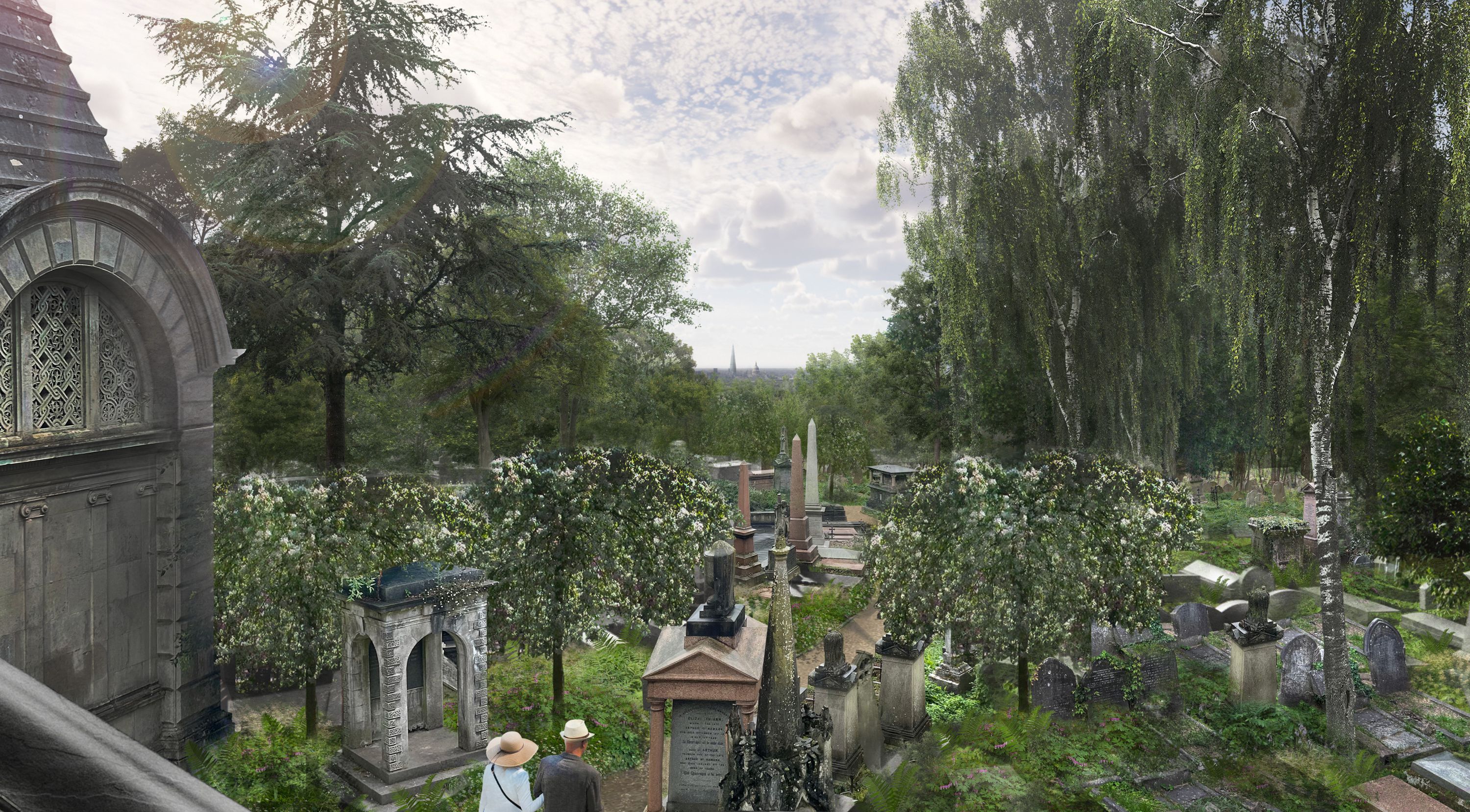
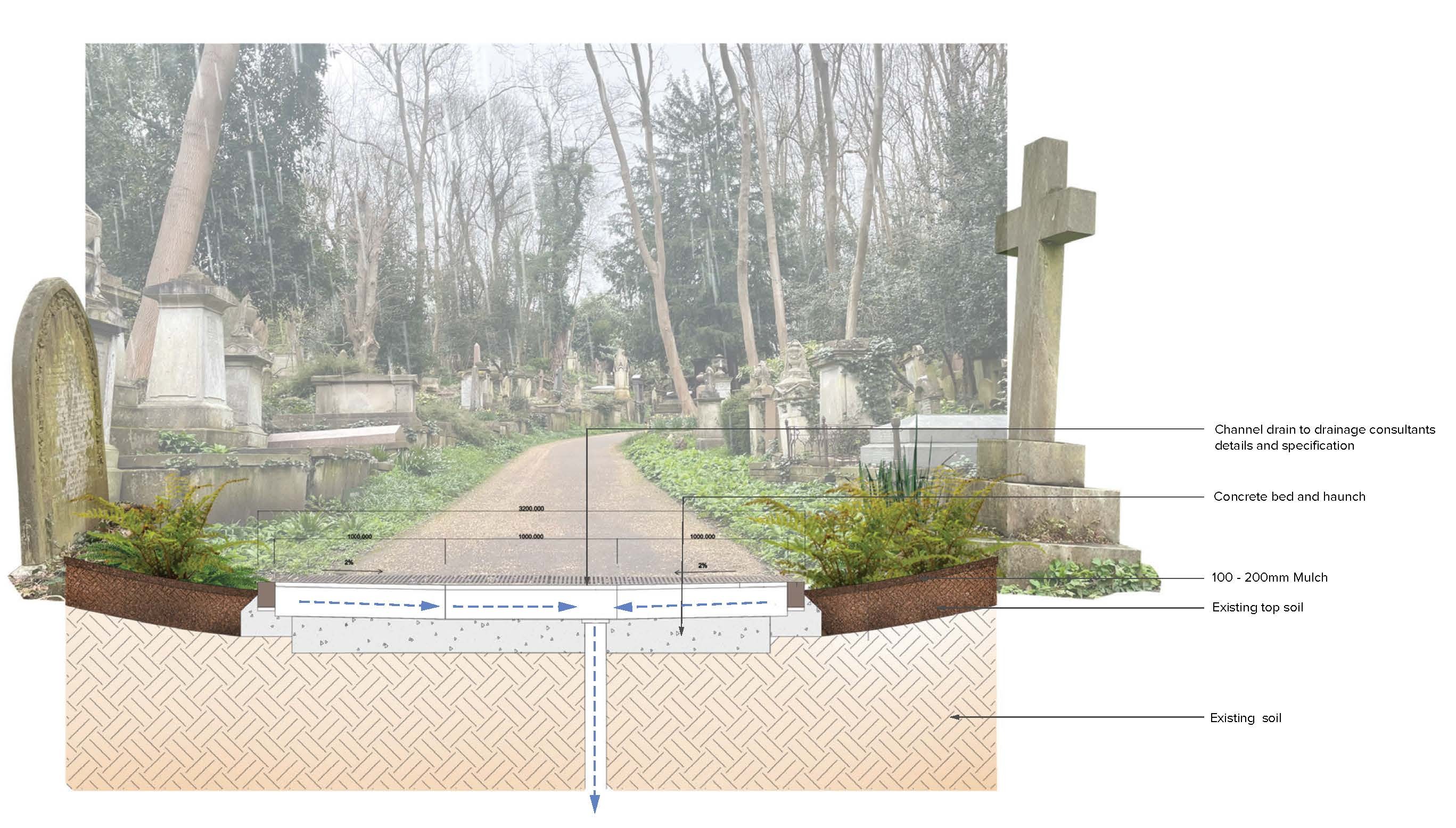
Phase 1: Stabilising and Opening Up the Site
The first phase of this programme, a £19.5m investment, focuses on the most urgent priorities. It brings together landscape recovery, targeted conservation and improved access in a coherent set of works designed to stabilise the site and address long-standing issues. This includes repairing and upgrading paths and drainage systems, replanting with climate-resilient species to restore the historic landscape character, and conserving key listed structures such as the Egyptian Avenue, Circle of Lebanon and Terrace Catacombs. These interventions are designed to build resilience, addressing the impacts of climate change, including increased rainfall, erosion and tree loss, while ensuring the Cemetery can be managed sustainably.
Access, Engagement and Wellbeing
Improving access is a central part of this phase. The project will make it easier for a wider range of people to visit and experience the Cemetery, through improved paths, step-free routes and better facilities.
Alongside this, an expanded programme of interpretation, learning and community engagement will improve ways for people to connect with the site, whether through heritage, nature, or its role as a place of reflection and wellbeing.
Highgate offers something increasingly rare in a city: space for reflection, connection and understanding.
Crucially, all of this is being delivered while balancing its historic significance with its ongoing purpose as a place of burial, remembrance and public benefit. Alongside landscape and conservation works, Phase 1 introduces targeted improvements to visitor facilities, including new public WCs, with more substantial upgrades to staff and volunteer facilities to follow in later phases.
Looking Ahead
The distinction between the long-term masterplan and the immediate Phase 1 works is important. The masterplan sets the direction for how the Cemetery will be cared for and sustained over the coming decades, while Phase 1 addresses the most pressing risks and establishes the basis for subsequent phases.
This approach marks a shift from reactive maintenance to a planned, sustainable model for managing both landscape and built heritage. But beyond the works and the investment, what is being secured is something harder to quantify: a place where history is present all around, and where, among the monuments and the trees, there is still room to think. Highgate Cemetery has survived neglect, near-abandonment and the pressures of a changing city. This is how we ensure it survives the next century and beyond.
Promoting excellence in public services
APSE (Association for Public Service Excellence) is a not for profit unincorporated association working with over 300 councils throughout the UK. Promoting excellence in public services, APSE is the foremost specialist in local authority frontline services, hosting a network for frontline service providers in areas such as waste and refuse collection, parks and environmental services, cemeteries and crematorium, environmental health, leisure, school meals, cleaning, housing and building maintenance.
.png)


.png)


